Showing posts with label alonzi. Show all posts

Tuesday, July 20, 2010

Charged Pion Branching Ratio: Part I

Inherent symmetries in nature lead to conservation laws (perhaps someone will make a post about Noether's Theorem). When we think about the stability of a sub-atomic particle we must think in these terms. Take for example the charged pion, in free space at the tree level. The particle* has mass and charge. (Don't forget to boost into the pion's rest frame) There are no lighter charged hadrons therefore the final state must include a charged lepton of less mass (ie an electron or muon). Our situation looks as follows


Now we invoke conservation of lepton number and conclude that we cannot make the lepton without an associated anti-lepton; charge conservation rules out all particles save neutrinos. So now we have


This situation is the end of the story for the vast majority of pion decays (99,999,999/100,000,000 times in fact). However we can sneak in another particle! The neutral pion is less massive than the charged pion by more than the mass of the electron so we can add a pi-zero to the electron channel (beta decay). We have now arrived at the complete picture.


The next step is to calculate the different decay rates for the various processes and that is a topic for part II!


* I'm playing fast and loose with what is a particle and what is an anti-particle, deal with it.

Tuesday, July 13, 2010

Mandelstam Variables

Two particle into two particle scattering is a common topic in the field of particle physics and is studied so often that special notation has been developed to facilitate discussion of such processes. The convention uses the "so-called" Mandelstam variables (s,t,u) where (p_i) represents the momentum of the four particles ():


These variables completely describe the momentum space of the problem in a Lorentz invariant way. One of the useful properties of this choice of variables is the fact that:


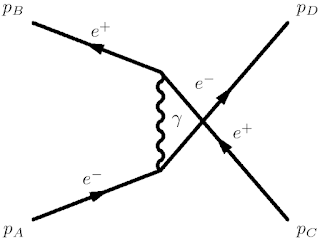
Furthermore we can elucidate these conditions by drawing the corresponding Feynman diagrams for each process.


s-channel
t-channel
u-channel

Thursday, July 1, 2010

Radiation Sources You Should Know

When working with particle detectors it is important to be able to confirm they are functioning properly. Often this process involves using calibrated radioactive sources. Care should be taken to use a source which produces radiation similar to what the detector is designed to measure. I was recently informed by Andries that (begin paraphrase) Someone at your level should really have memorized all the useful sources (end paraphrase). Once again the great work of Science-Nonfiction by Leo comes to the rescue. Here is a summary of the common sources particle physicist use (from Leo).

Sunday, June 27, 2010

You know nothing

It is common for physics grad students to remember the angular momentum operator . Many will even remember that it commutes with and we can therefore form a set of simultaneous eigenfunctions to describe a particle in angular momentum space. Some may even recall that the standard conventions yield the following eigenequations.


But do you know how to demonstrate that and are the eigenvalues for and ?

for Stache:

Monday, June 21, 2010

Particle Decay is a Random Phenomena: Part II

The formalism behind random decay is simple. Take to be the number of particles and the probability that a particle will decay in a given time. We can then write the differential euquation for the number of partices as follows:

.

Where represents the "lifetime" of the particle. Upon integrating we arrive at the familiar characteristic of exponential decay


Where this math gets interesting is when a particle can decay in multiple ways. Each additional decay channel should decrease the overall "lifetime" of the particle. The savvy observer notices that "lifetimes" add like resistors in parallel.

Of course determining why the different channels have different decay rates involves physics, namely:

.

See you next time when put the pion together with this equation and explore the physics of branching ratios.

Charged Pion Decay

Pions are the lightest hadrons and therefore the charged pion can only decay into a neutral pion (beta decay) and/or lighter leptons (electrons and muons). The decay must conserve charge and lepton number; since we need a final state with a charge carrying lepton we must also have the associated neutrino to conserve lepton number. Therefore the weak force is the only mechanism by which the decay may proceed. Thus we arrive at the first order diagram for charged pion decay is as follows (beta decay would manifest itself as a radiating from the blob):
The first vertex is indicated with a blob because the pion is a composite particle and the interaction of the constituent quarks is not fully understood. The outgoing particles are an anti-lepton and its associated neutrino (either a positron or a muon). From the diagram we see that the physics of the decay is independant of which lepton we choose, this independance is known as lepton universality. By examining pion decays and measuring the ratio of electron to muon decays we can test the concept of universality.

Thursday, June 17, 2010

Better Know a Particle: The Pion

Yukawa proposed a theory of strong interactions involving a "meson mediator particle" in 1935. The following year the physics community thought they had discovered the particle but in fact they have found the mu meson. Eventually in 1947 experiments conducted in the Pyrenees and the Andes mountain ranges discovered this elusive particle which have come to know as the pion.


The reason for the mountains was simply that high energy particle accelerators were not a common tool for physics yet. The Cosmotron was not powered up until 1953 and the Bevatron wouldn't see beam till the following year. So physicists had to hike up a mountain in the hopes of seeing a pion created by cosmic collisions in the atmosphere.

Jumping forward a few decades we now know plenty about the pion. There are three flavours:. With identical masses for the charged flavours of approximately 140 MeV/c/c and slightly lower mass for the neutral flavour. The charged pions are each other's antiparticles but the discussion of the neutral pion's antiparticle is best left to another post. Pions are bound states of the lightest quarks, and as mesons are a quark-antiquark pair ().

Finally pions are unstable particles. The neutral pion decays electromagnetically into two photons with a mean lifetime around . The decay of the charged pion is very interesting and follows the form where the neutrino has opposite lepton number of the muon. Not only is this decay a weak decay and thus on a much slower timescale (26ns) but naively one would expect to be a more common decay mode due to larger phase space. The topic of why the muon channel dominates is again a topic for another post.

Links to Experiments and Results about pions:

Particle Decay is a Random Phenomena: Part III

Now that we understand what it means for a process to be random let's delve into the mathematics. The most important distribution to understand is the Poisson distribution. The probability of exactly n Poisson occurrences during a time interval where were expected is:


To satisfy the Poisson conditions events must be occurring with an average rate and be independent of each other, decaying pions certainly qualify. There are some interesting and useful features of this distribution. For instance the mean ()and the variance () are equal to . That means the standard deviation of a Poisson distributed data set is .

Say we measure 1,000,000 pions decays. We now want to state our measurement of the branching ratio (). How do we determine the statistical error of our measured value ()? Since we know the decays obey Poisson statistics we simply use the features we learned above combined with standard statistical estimation rules:


The important thing to note is that the "one over square root of N" has nothing to do with Poisson statistics but rather is a feature of sampling error.

Particle Decay is a Random Phenomena: Part I

The standard model tells us that all particles of the same type are indistinguishable. Therefore when describing a system of multiple particles (of the same time) we must take great care to insure our particles are treated as indistinguishable. Accidentally treating particles as identical can cause serious miscalculations. For example (not physics but very illustrative):

For the following questions assume I have two children, child A and child B: the probability of any individual child being a boy is 1/2, the probability of the child being born on a Tuesday is 1/7, etc. For each question I will apply a different set of constraints. Only the constraints mentioned in the question affect that question.

Q1: What is the probability I have two boys?
A1: 1/4.
Q2: Child A is a boy. What is the probability I have two boys?
A2: 1/2.
Q3: At least one of my children is a boy. What is the probability I have two boys?
A3: 1/3.
Q4: At least one of my children is a boy born on Tuesday. What is the probability I have two boys?
A4: 13/27.

The reason for the counterintuitive answers to questions 3 and 4 is that we don't know which child (A or B) satisfies the constraint. Since it could be either the probability of overlap changes the result. The more (less) probable the overlap the closer the answer is to 1/3 (1/2).

But what does this have to do with particle decay?
Quantum Mechanics says there are no hidden variables. If the time a particle had been "alive" affected the probability it would decay in the future then there would have to be some hidden variable to fully describe the particle! If we could look at a particle and tell how long it had been alive then particles would not be indistinguishable!

Particle Decay is a Random Phenomena: Prelude

Before we begin, a small exercise:

The probability for a pion to decay in 26ns is .
Q: We make a pion. What is the probability that it decays during the next 26ns?
A: .
Q: We make a pion. It lives for 26ns. What is the probability that it decays during the next 26ns?
A: .
Q: We find a pion sitting on the sidewalk. What is the probability that it decays during the next 26ns?
A: .

Often people get confused when thinking about particle decay. The reason for the confusion is that particles decay randomly and humans inherently do not understand randomness. Further confounding the problem is the human desire to treat everything else like a human. To this extent we say particles have a lifetime, which implies the particle has an age. But in fact the probability that a particle would have decayed in the previous second is the exact same as the probability that it will decay in the next second. The pion could be 1 million years old and the probability of it decaying in the next 26ns is still . However that is one unlikely pion to still be "alive".
Mathematically speaking: ; is the number of pions, and is the decay rate of pions.